
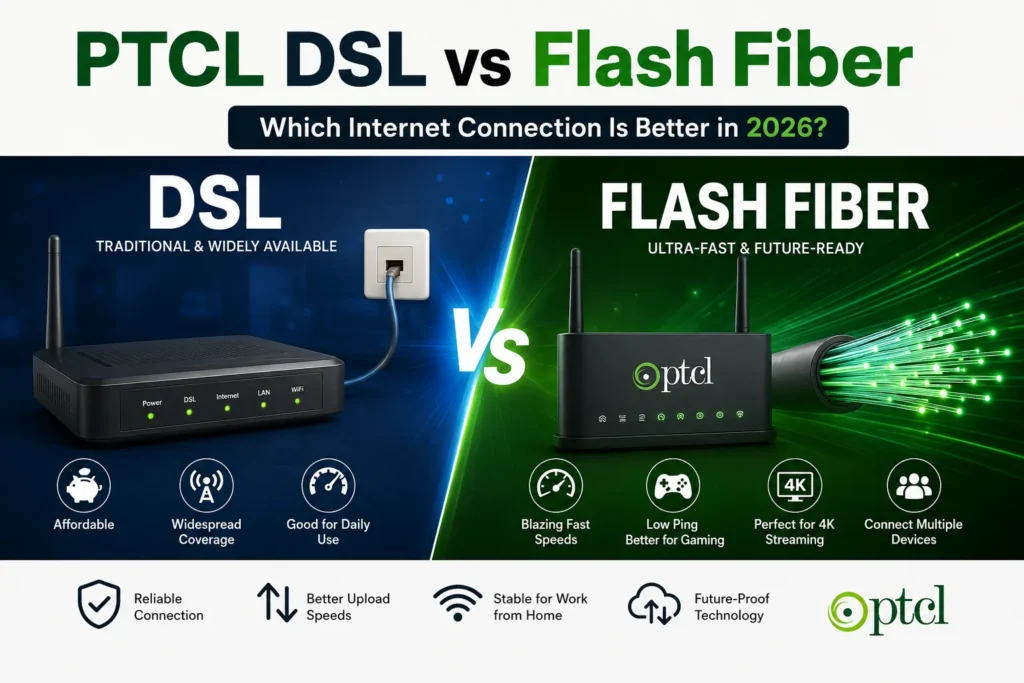
If you’re setting up a new connection or thinking about switching, “DSL or Fiber” is usually the first real decision to make with PTCL. The two technologies aren’t just different speed tiers of the same thing — they run on completely different infrastructure, and that difference shows up in day-to-day use in ways a spec sheet doesn’t always make clear.
This guide walks through how each one actually works, where they differ in real use — gaming, streaming, video calls, reliability — and how to figure out which one fits your household, not just which one sounds faster on paper.
What Is PTCL DSL?
• Choose Flash Fiber if it’s available and you stream in 4K, work from home, or play online games.
• Choose DSL if Flash Fiber isn’t available, your internet usage is moderate, and you want a lower monthly cost.
For most users, Flash Fiber offers better performance, but DSL remains a practical option in areas without fiber coverage.
How it works: DSL delivers internet over the same copper telephone wiring that’s already installed in most homes with a PTCL landline. A DSL modem splits the signal so voice calls and internet data can travel over the same physical line without interfering with each other.
Copper telephone lines: This is the defining feature of DSL, for better and worse. Because it reuses existing phone infrastructure, PTCL didn’t need to lay new cable to bring DSL to most areas — which is exactly why it reaches far more towns and neighbourhoods than fiber currently does. But copper wire wasn’t originally built for high-speed data, and its performance is affected by distance and physical condition in a way fiber isn’t.
Advantages:
- Available in far more locations than Flash Fiber, including many smaller towns and older neighbourhoods
- Generally quicker and simpler to install, since the line is often already in place
- Sufficient for everyday browsing, email, calls, and standard streaming
- Usually the more affordable entry point for a first-time connection
Limitations:
- Speed drops the farther your home is from the local telephone exchange — this is a physical limitation, not a service fault
- More sensitive to line quality: old wiring, moisture, or loose connections can degrade performance
- Upload speeds are typically lower than fiber, which matters for calls and cloud uploads
- Harder to sustain performance across many devices or heavy simultaneous usage
Best for: Households with light to moderate usage — browsing, email, standard video calls, HD (not necessarily 4K) streaming — especially in areas where Flash Fiber isn’t yet available.
What Is PTCL Flash Fiber?
Flash Fiber is PTCL’s fiber-to-the-home (FTTH) service, and it represents a fundamentally different way of delivering the connection into your house.
FTTH technology: Instead of copper wire, Flash Fiber uses fiber-optic cable that runs directly to an ONT (Optical Network Terminal) installed at your home, which then connects to your WiFi router. Data travels as pulses of light through glass fiber rather than as electrical signals through copper.
Fiber optic cable: This is the core reason fiber outperforms DSL in most real-world comparisons. Light signals over fiber don’t degrade with distance the way electrical signals over copper do, and fiber isn’t vulnerable to the same electrical interference or line-quality issues that affect DSL.
Advantages:
- Significantly more consistent speeds, especially during peak hours
- Stronger, more symmetrical upload speeds — a real benefit for calls, cloud backups, and content creators
- Lower and steadier ping, which matters for gaming and real-time applications
- Better suited to multi-device households and heavy simultaneous use
Limitations:
- Availability is address-specific — even within a city with “Flash Fiber coverage,” your exact street may or may not be reached yet
- Installation typically requires new fiber cabling to your home, which can take longer to set up than DSL
- Generally priced higher than equivalent DSL tiers, particularly at higher speed levels
Best for: Households that stream in HD/4K, work from home, game online, run several devices at once, or simply want a more consistently fast connection — provided it’s available at your address.
DSL vs Flash Fiber Comparison Table
| Feature | DSL | Flash Fiber |
|---|---|---|
| Connection type | Copper telephone line | Fiber-optic cable (FTTH) |
| Technology | Electrical signal over copper | Light signal over glass fiber |
| Download speed | Lower, distance-dependent | Higher, more consistent |
| Upload speed | Lower | Higher, closer to symmetrical |
| Ping | Higher, more variable | Lower, more stable |
| Gaming | Workable for casual play | Better suited for competitive/real-time gaming |
| Streaming | Good for SD/HD | Better suited for HD/4K and multiple simultaneous streams |
| Work from home | Adequate for standard calls | Stronger for video calls, large file transfers |
| Reliability | More affected by line condition and distance | Generally more stable |
| Weather effect | Can be affected by moisture/line damage | Less affected by weather, though not immune to physical fiber damage |
| Installation | Often faster, uses existing phone line | Requires new fiber cable, may take longer |
| Availability | Wider, including smaller towns | Limited to specific covered addresses |
| Best users | Light to moderate users, budget-conscious households | Streamers, gamers, remote workers, multi-device homes |
PTCL DSL Pros
✓ Available almost everywhere
✓ Lower monthly cost
✓ Easy installation
✓ Good for basic internet use
PTCL DSL Cons
✗ Lower upload speed
✗ Higher latency
✗ Speed decreases with distance
✗ Not ideal for many users simultaneously
DSL vs Flash Fiber: Which One Wins?
| Category | Winner |
|---|---|
| Gaming | Flash Fiber |
| Streaming | Flash Fiber |
| Video Calls | Flash Fiber |
| Availability | DSL |
| Price | DSL |
| Upload Speed | Flash Fiber |
| Reliability | Flash Fiber |
| Overall | Flash Fiber |
Speed Comparison
On paper, both DSL and Flash Fiber list a range of speed tiers, so comparing them purely by advertised numbers can be misleading. The more useful comparison is consistency — how close your actual speed stays to what’s advertised, especially during busy hours.
DSL’s biggest constraint is physical distance from the exchange. Two homes on the same DSL package can get noticeably different real-world speeds simply based on how far each one sits from PTCL’s local exchange and the condition of the copper line feeding it. Flash Fiber doesn’t have this same distance penalty — a home close to the fiber node and a home farther away, both within the covered service area, generally see far less variation.
The practical takeaway: if you’ve been told your DSL package supports a certain speed but you’re consistently getting less, that’s often the technology itself, not a fault to report. Fiber removes much of that gap between “advertised” and “actual.”
If you want to see how your own connection currently performs, run a PTCL SPEED TEST and compare it against your package’s advertised range.
Gaming Performance
For gaming, download speed matters less than most people assume — ping and consistency matter more.
Ping (latency) measures how quickly your device communicates with a game server. DSL’s copper-based transmission tends to produce higher and more variable ping than fiber, especially under load from other devices on the same connection. Flash Fiber’s more stable, lower-latency path generally makes for a smoother experience in real-time, competitive games where every millisecond of lag is noticeable.
For casual or single-player gaming, DSL is often perfectly workable. For competitive online gaming, especially where reaction time matters, Flash Fiber’s lower and steadier ping tends to be the more noticeable, appreciated difference over raw download speed.
Streaming Performance
Netflix and YouTube: Both DSL and Flash Fiber can handle standard and HD streaming comfortably on an appropriately sized package. The difference becomes clearer with 4K streaming or when multiple people are streaming simultaneously in the same household — fiber’s more consistent bandwidth handles this combination more gracefully than DSL, which can start to show strain as more simultaneous demand hits a distance-limited connection.
Buffering during streaming is often less about your advertised download speed and more about consistency under load — this is exactly where fiber’s steadier performance shows its advantage, particularly during peak evening hours when many households are streaming at once.
Upload Speed Comparison
Upload speed is where the gap between DSL and Flash Fiber tends to be most noticeable in daily life, because DSL’s asymmetric design gives it meaningfully less upload capacity than download.
Video calls: A weak upload speed is often the reason your video freezes or drops for the other person on a call, even when your download speed looks fine. Fiber’s stronger upload capacity generally makes for a more stable calling experience.
Google Drive and Dropbox: Uploading files — documents, photos, project folders — to cloud storage depends entirely on upload speed. Large uploads on DSL can take noticeably longer than the same task on Flash Fiber.
Cloud backup: Automatic backups (phone photos, laptop backups) run in the background and compete for the same limited upload bandwidth on DSL. On fiber, this is far less likely to be felt during everyday use.
Reliability Comparison
Power failures: Both DSL and Flash Fiber require power to your router/ONT to function, so neither survives a power outage without a backup power source (UPS) at home. This is essentially a tie between the two.
Line issues: DSL is more prone to performance issues stemming from old or damaged copper wiring, loose junctions, or moisture ingress into line infrastructure. Fiber isn’t immune to physical damage, but it doesn’t carry the same electrical degradation risks copper does.
Weather: Copper lines can be more susceptible to interference and gradual degradation from prolonged moisture exposure. Fiber-optic cable is generally more resistant to this kind of weather-related wear.
Copper damage vs. fiber damage: Both types of cable can be physically damaged — during construction work, for instance — but copper deterioration tends to happen more gradually and less predictably, while fiber faults are often more immediately obvious (a complete loss of signal rather than a slow decline).
Price Comparison
Package pricing for both DSL and Flash Fiber changes periodically, and PTCL has revised its rate cards more than once in recent memory. Rather than quote specific figures here that may already be outdated by the time you’re reading this, the more reliable approach is to check PTCL’s official packages page directly for current pricing before making a decision.
As a general pattern, Flash Fiber packages tend to be priced higher than comparable DSL tiers, particularly at higher speed levels — but the gap and the exact numbers should always be confirmed at the source rather than assumed. See PTCL Packages for a broader breakdown of what’s currently offered across both technologies.
Which One Should You Choose?
Students: DSL is often enough for coursework, research, video lectures, and casual streaming — especially where budget matters more than maximum speed.
Families: If multiple people are streaming, browsing, and video calling at the same time, Flash Fiber’s consistency under simultaneous load is usually the more comfortable choice, where available.
Gamers: Flash Fiber’s lower, steadier ping makes a real difference for competitive or real-time online gaming. Casual gamers may find DSL entirely sufficient.
Businesses: Reliable upload speed and consistent performance during business hours make Flash Fiber the stronger fit for most small offices, particularly those relying on cloud tools or frequent video conferencing.
Remote workers: Video calls and file uploads are where DSL’s limitations show up most. Flash Fiber’s stronger upload speed tends to make remote work noticeably smoother.
Budget users: DSL remains the more affordable entry point in most cases, and is a reasonable choice if your usage is light to moderate.
Heavy downloaders: Large, frequent downloads benefit from Flash Fiber’s higher, more consistent speeds — though the right tier matters as much as the technology itself.
How to Check Flash Fiber Availability
Because Flash Fiber coverage is address-specific rather than city-wide, the only reliable way to know if it’s available at your home is to check directly rather than assume based on your general area. PTCL’s official website offers an availability check where you can enter your address or contact number to confirm coverage.
For a more detailed look at checking coverage by city, see Is PTCL Fiber Available in My Area?.
Our recommendation:
If Flash Fiber is available at your address, it’s the better long-term choice for most households because of its faster speeds, lower latency, and stronger upload performance. DSL remains an excellent option where fiber hasn’t yet reached.
Is PTCL Flash Fiber faster than DSL?
Generally, yes — Flash Fiber typically offers higher and more consistent speeds than DSL, particularly for upload speed and performance during busy hours.
Can I switch from DSL to Flash Fiber?
Usually yes, if Flash Fiber is available at your address. This typically involves a new fiber installation rather than a simple upgrade, since it’s a different physical connection.
Is DSL still worth choosing in 2026?
Yes, particularly where Flash Fiber isn’t available yet, or where your usage is light to moderate and budget is a priority. DSL remains a genuinely useful option, not an outdated one.
Does distance from the exchange affect Flash Fiber the way it affects DSL?
Not in the same way. Fiber-optic signals don’t degrade with distance the way electrical signals over copper do, so Flash Fiber doesn’t carry DSL’s distance-based speed penalty within its covered service area.
Which is better for online gaming, DSL or Flash Fiber?
Flash Fiber generally offers lower, more stable ping, which benefits real-time and competitive gaming. DSL can be sufficient for casual or single-player gaming.
Is Flash Fiber available everywhere PTCL offers DSL?
No. Flash Fiber availability is limited to specific covered addresses and is still expanding, while DSL reaches a much wider area through existing telephone infrastructure.
Why is my upload speed so much lower than my download speed on DSL?
DSL is designed asymmetrically, with less bandwidth allocated to uploads than downloads. This is standard for the technology, not a fault — Flash Fiber typically offers a narrower gap between the two.
Does weather affect PTCL DSL performance?
It can. Prolonged moisture exposure and general wear on copper lines can gradually affect DSL performance more than it affects fiber-optic cable.
How do I know which package speed I actually need?
It depends on your household’s usage — number of devices, whether you stream in HD or 4K, work from home, or game online. Reviewing your typical daily use is a better guide than picking the highest available tier by default.
How can I check if I’m getting the speed I’m paying for?
Run a [PTCL Speed Test] and compare your result against your package’s advertised speed. For help interpreting the numbers, see What Do My PTCL Speed Test Results Mean?, and if your results are consistently low, Why Is My PTCL Internet Slow? walks through how to narrow down the cause.
Our recommendation:
The PTCL Speed Test editorial team researches Pakistan’s broadband services, including PTCL DSL, Flash Fiber, EVO, and CharJi. Our guides are regularly updated to reflect current network technology, package changes, and real-world performance, helping users choose the right internet connection with confidence.
Still Not Sure Which Connection Is Right?
If you’re already using PTCL, run our PTCL Speed Test to check your download speed, upload speed, ping, and jitter. Comparing your actual results with your subscribed package is the easiest way to decide whether it’s time to upgrade from DSL to Flash Fiber.