
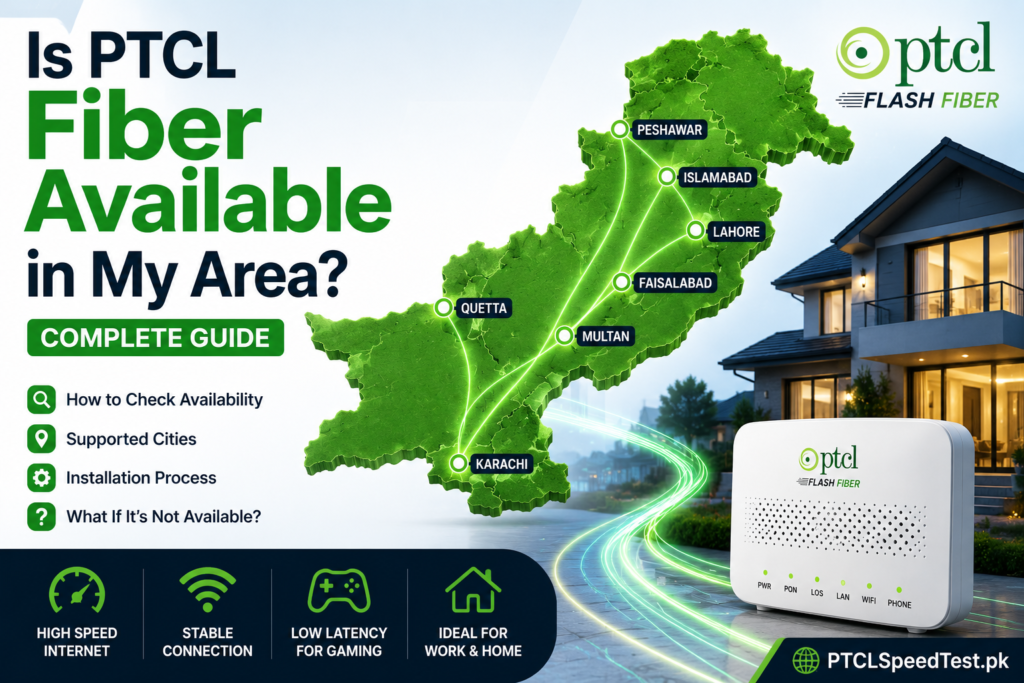
Flash Fiber sounds like exactly what your home internet needs — until you try to sign up and find out it’s not available at your address, while a friend two streets over already has it installed. This isn’t random. Fiber coverage in Pakistan, including PTCL’s, is built neighborhood by neighborhood, not city-wide overnight. This guide walks through how to actually check availability, which cities currently have coverage, why coverage expands the way it does, what to do if you’re not covered yet, and what to expect once you are.
Table of Contents
What Is PTCL Flash Fiber?
Flash Fiber is PTCL’s fiber-to-the-home (FTTH) internet service. Instead of running over the copper telephone lines that DSL depends on, Flash Fiber uses fiber-optic cable that runs directly to your home, connecting to an ONT (Optical Network Terminal) that then feeds your WiFi router.
This is the core reason Flash Fiber generally performs more consistently than DSL — fiber-optic signals don’t degrade over distance or line condition the way electrical signals over copper do. The tradeoff is that fiber requires new physical infrastructure to reach each neighborhood, which is exactly why availability is more limited than DSL’s.
How to Check PTCL Fiber Availability
Since coverage is address-specific rather than city-wide, the only reliable way to know if Flash Fiber reaches your home is to check directly. A few ways to do this:
Official PTCL website. PTCL provides a coverage checker where you can select your city and confirm Fiber to Home availability for that area. This is the most direct and current source, since PTCL updates it as new areas are connected.
PTCL customer support. Reaching out to support directly lets you confirm availability for your exact address, including cases where the online checker might not reflect very recent rollouts.
Helpline. Calling PTCL’s helpline is a straightforward way to get a same-day answer if you’d rather not wait for a website check or a support ticket.
Nearby installation. If a PTCL technician has recently installed Flash Fiber at a nearby address, that’s often a strong sign infrastructure has reached your street, though it doesn’t guarantee your specific home is covered without confirming.
Existing neighbors. Asking neighbors whether they already have Flash Fiber is a quick, informal way to gauge likely availability before going through an official check.
What to have ready before you check. Whichever method you use, having a few details on hand speeds things up: your full address including sector or block, the nearest well-known landmark, a working phone number PTCL can reach you on, and if you’re an existing PTCL customer, your account or landline number. Coverage checkers and support staff generally need your exact address rather than a general area, since two houses on the same street can technically fall on different sides of a coverage boundary.
Coverage Check Methods
| Method | Reliability | Recommended |
|---|---|---|
| Official PTCL website checker | High — kept current | Yes, start here |
| PTCL customer support | High — confirms exact address | Yes, especially for edge cases |
| Helpline call | High — quick and direct | Yes |
| Nearby installation | Moderate — a good sign, not a guarantee | Useful, but confirm officially |
| Asking neighbors | Low — informal only | Fine as a first hint, not a final answer |
Cities Where PTCL Flash Fiber Is Available
Based on PTCL’s own coverage listings, Flash Fiber is currently available in parts of these cities:
- Lahore
- Karachi
- Islamabad
- Rawalpindi
- Faisalabad
- Multan
- Gujranwala
- Peshawar
- Hyderabad
- Quetta
It’s important to be precise about what this means: being on this list doesn’t mean the entire city is covered. Coverage tends to be more established in developed, higher-density sectors — the kind of neighborhoods where infrastructure investment reaches first — while newer housing societies and outlying areas within the same cities may still be waiting for connection, even in cities that have had Flash Fiber for years.
Coverage depends on PTCL’s ongoing network expansion and your specific location, and continues to grow over time. Always confirm your exact address through the official checker rather than assuming based on your city alone — being in a “covered” city is a starting point, not a confirmation.
Why Fiber Coverage Expands Unevenly
It’s worth understanding why fiber rollout looks the way it does, since it explains a lot of the frustration people feel when a nearby street has coverage and theirs doesn’t.
Distance from existing infrastructure. Fiber networks expand outward from existing distribution points. A street closer to an already-built fiber node is naturally cheaper and faster to connect than one farther away, even within the same general area.
Population density. Areas with more homes per stretch of cable generally get prioritized earlier, since the same infrastructure investment reaches more potential customers.
Newer housing developments. Recently built societies or blocks sometimes wait longer for fiber simply because the surrounding infrastructure is newer and rollout hasn’t caught up yet, even if the area itself is otherwise well-developed.
Right-of-way and permissions. Laying new cable sometimes requires coordination with local authorities or property arrangements, which can add time to reaching a specific street even when there’s clear demand.
Demand signals. Areas where more residents have expressed interest or requested service sometimes get prioritized sooner, which is part of why registering interest genuinely matters rather than just being a formality.
None of this is unique to PTCL — it’s a general pattern in how fiber networks expand anywhere. Understanding it doesn’t make the wait shorter, but it does explain why “my neighbor has it and I don’t” is common rather than an error.
How to Request Fiber in Your Area
If Flash Fiber isn’t available at your address yet, there are still a few practical steps worth taking:
Register interest. PTCL allows customers to express interest in Flash Fiber for their area, which can factor into future rollout planning for that location.
Contact PTCL directly. Speaking with PTCL support about your specific address can clarify whether expansion to your area is already planned or under consideration.
Nearby deployment. If Flash Fiber has recently reached a nearby street or sector, that’s often a sign your area may be next — worth checking back periodically rather than assuming it will never arrive.
Waiting list. In some cases, PTCL maintains informal waiting interest for areas with enough demand, which can help prioritize future expansion — asking directly is the best way to find out if this applies to your location.
Follow up periodically, not constantly. Since rollout timelines aren’t fixed or published for specific streets, checking back every few months is more useful than repeated calls in a short window — coverage genuinely does expand gradually, and revisiting the official checker occasionally is often enough to catch the change.
What If Fiber Is Not Available?
If Flash Fiber isn’t available at your address, you’re not without options:
DSL. PTCL’s DSL service reaches far more locations than Flash Fiber currently does, since it runs over existing telephone line infrastructure. It’s a genuinely solid choice for browsing, streaming, and general household use while you wait for fiber to expand to your area. See PTCL Packages for current DSL tiers.
Current connection. If you already have a working PTCL DSL connection, there’s often no urgency to switch immediately — DSL can comfortably handle a wide range of everyday usage, and you can reassess once Flash Fiber becomes available at your address.
Understand what you’re actually getting from DSL in the meantime. While you wait, it’s worth knowing your DSL connection’s real performance rather than assuming it’s simply “worse.” DSL connections can vary a lot in ping and jitter depending on line distance and quality — worth understanding if you’re relying on it for calls or gaming in the meantime. See PTCL Ping & Jitter Explained for what those numbers mean for your day-to-day experience.
Future rollout. PTCL’s fiber network has been expanding steadily, and areas without coverage today are reasonable candidates for future expansion — though PTCL doesn’t publish fixed timelines for when a specific street or sector will be connected, so it’s best to check back periodically rather than expect a guaranteed date.
Benefits of Flash Fiber
Where it is available, Flash Fiber offers some genuine advantages over DSL worth knowing about while you wait or decide:
Lower latency. Fiber-optic transmission tends to produce more stable, lower ping than copper-based DSL, which matters for anything real-time.
Higher upload speed. Fiber connections generally offer stronger, more balanced upload speeds compared to DSL’s typically asymmetric design, where download is prioritized far more heavily than upload. This is one of the more underrated differences between the two — see PTCL Download vs Upload Speed for why this specifically matters for calls, cloud uploads, and live streaming.
Stable speeds. Because fiber doesn’t share DSL’s distance-based degradation, performance tends to stay more consistent regardless of how far your home is from the local exchange.
Streaming. More consistent bandwidth makes Flash Fiber better suited to HD and 4K streaming, especially with multiple screens active at once.
Gaming. Lower, steadier latency benefits real-time and competitive gaming more than raw download speed alone would.
Work from home. Stronger upload performance supports smoother video calls, screen sharing, and cloud-based work tools.
DSL vs Flash Fiber Availability
| Feature | DSL | Flash Fiber |
|---|---|---|
| Infrastructure | Existing copper telephone lines | New fiber-optic cable |
| Availability | Much wider, including smaller towns | Limited to specific covered addresses in select cities |
| Typical rollout | Already reaches most PTCL landline areas | Expanding gradually, neighborhood by neighborhood |
| Best if | Fiber isn’t available at your address yet | Available and you want stronger, more consistent performance |
For a fuller breakdown of how the two technologies compare on everyday performance, not just availability, see PTCL DSL vs Flash Fiber.
How Long Does Installation Take?
Once Flash Fiber is confirmed available at your address, installation generally follows a standard process:
Installation Process
| Step | Typical Time |
|---|---|
| Site survey | A few days after request, to confirm technical feasibility at your exact address |
| Approval | Following a successful survey, before installation is scheduled |
| Installation | Scheduled visit for running the fiber line and setting up the ONT |
| Activation | Final step, usually completed the same day as installation once equipment is connected |
During the site survey, a technician typically checks the physical path the fiber cable would need to take to reach your home from the nearest distribution point, and confirms whether any additional equipment or cabling adjustments are needed. This step determines whether your specific address gets a straightforward “yes,” a “yes, with some additional work,” or, in some cases, a “not yet,” even within an otherwise covered area.
Exact timelines can vary by location and current demand, so it’s worth confirming an estimated schedule directly with PTCL when you place your request rather than assuming a fixed number of days.
Ready to Check Your Connection?
Whether you’re already on Flash Fiber, still on DSL while you wait, or just confirmed you’re finally covered, the next useful step is the same: know what you’re actually getting. Run a PTCL Speed Test to see your real download speed, upload speed, ping, and jitter — it takes under a minute, and it’s the clearest way to know whether your current connection matches what you’re paying for, or whether it’s time to explore PTCL Packages for an upgrade.
Frequently Asked Questions
Is PTCL Fiber available in my city? It depends on your exact address, not just your city. PTCL Flash Fiber currently covers parts of several major cities, but coverage is neighbourhood-specific — check directly through PTCL’s official coverage checker for your address.
Can I request PTCL Fiber for my area? Yes, you can register interest or contact PTCL directly to ask about your specific location, which can help inform future expansion planning.
How do I check PTCL Fiber coverage? The most reliable way is PTCL’s official coverage checker, followed by contacting customer support or the helpline for direct confirmation of your address.
How long does Flash Fiber installation take? It typically follows a survey, approval, installation, and activation process, though exact timing can vary by location — confirm an estimate directly with PTCL when you request installation.
Can my DSL connection be upgraded to Flash Fiber? Generally yes, if Flash Fiber is available at your address. This usually involves a new fiber installation rather than a simple plan change, since it’s a different physical connection.
What if my neighbors already have Flash Fiber but I don’t? This can happen because coverage is address-specific rather than street-wide in some cases. It’s worth checking directly with PTCL, since your exact address may still need separate confirmation even if nearby homes are connected.
Does Flash Fiber use the same telephone lines as DSL? No. Flash Fiber uses dedicated fiber-optic cable, separate from the copper telephone lines DSL relies on.
Is Flash Fiber available in villages or rural areas? Coverage is currently concentrated in and around major cities. Rural and smaller-town areas are less likely to have coverage today, though PTCL’s fiber footprint has been expanding over time.
What should I do if Flash Fiber isn’t available at my address? DSL remains a solid option in the meantime for most household usage. You can also register interest in Flash Fiber for your area and check back periodically as coverage expands.
Is Flash Fiber more expensive than DSL? Flash Fiber packages are generally priced higher than comparable DSL tiers. See PTCL Packages for current pricing across both.
Why is Flash Fiber not available everywhere yet? Unlike DSL, which reuses existing telephone infrastructure, Flash Fiber requires new fiber-optic cable to be physically laid to each area, which naturally takes longer to roll out nationwide — a process shaped by distance from existing infrastructure, population density, and local permissions.
Will PTCL Fiber eventually reach my area if it’s not available now? PTCL’s fiber network has been expanding steadily, and areas without coverage today are reasonable candidates for future rollout, though no fixed date can be guaranteed for any specific location.
پلیز ہمارے علاقے نارتھ کراچی سیکٹر 11 ای میں فلیش فائبر کی سروس دے دیجئے
جزاک اللہ خیرا
Salam humare Ghar ptcl kafi time se use karte hai lekin AP ka flashfiber humare area Mai abhi Tak nai aya kindly plz flash fiber yaha bhi de