
Published by PTCLSpeedTest.pk Editorial Team
Last Updated: August 2026
Introduction
If your Ufone connection feels slower than it should, or you simply want to know your real numbers before making a decision about your plan, running a proper speed test settles the question quickly. Ufone — now part of Pakistan Telecom Mobile Limited (PTML) following its 2026 merger with Telenor Pakistan — is one of the country’s major mobile operators, and like every mobile network, actual performance depends heavily on your location, device, and how busy the network is at that moment. This guide gives you a free way to check your Ufone speed, explains what the numbers actually mean, and walks through practical fixes if something feels off.
Free Ufone Speed Test Tool
Use the tool above to test your Ufone internet speed right now. It measures download speed, upload speed, and ping in under a minute, on 4G or 5G where available. No app to install, nothing to sign up for — just run it and see your real numbers.
How to Test Ufone Speed
On Desktop: Open this page in any browser on your computer while connected to Ufone internet — through a Ufone 4G/5G hotspot device, for instance — and click the test button above.
On Android: Open this page directly in your phone’s browser with WiFi turned off, so you’re testing your actual Ufone mobile connection, then run the test.
On iPhone: Same process — open this page in Safari or Chrome, confirm you’re on Ufone mobile data rather than WiFi, and start the test.
4G Device / MiFi: If you’re using a standalone Ufone 4G device or MiFi unit rather than a phone, connect a laptop or phone to its WiFi output and run the test from there — the result reflects the device’s connection to Ufone’s network.
Best practices: Close other apps that might be using data in the background, and if you can, test with the device stationary rather than moving, since movement between towers can affect the result mid-test.
How Internet Speed Test Works
A speed test breaks your connection down into a few measurable parts:
Download speed — how fast data reaches your device from the internet, in Mbps. Affects browsing, streaming, and downloads.
Upload speed — how fast data leaves your device, in Mbps. Affects video calls, uploading content, and live streaming.
Ping — the round-trip time for a signal to reach a server and return, in milliseconds. Lower is better, particularly for gaming and calls.
Latency — essentially the same concept as ping, describing the delay in your connection’s responsiveness.
Jitter — how much your ping varies between moments. A connection with low, steady jitter feels noticeably smoother than one with similar average ping but constant fluctuation.
Packet loss — the percentage of data that fails to reach its destination at all and has to be resent. Even a small amount of packet loss can cause stutter in calls or noticeable lag in games, separate from your raw speed numbers.
What Is Good Ufone Speed?
There’s no universal “good” number — it depends on what you’re actually doing. Here’s a practical guide:
| Speed | Browsing | HD Video | Gaming | Video Calls |
|---|---|---|---|---|
| 2 Mbps | Slow page loads | Frequent buffering | Not recommended | Poor quality, frequent drops |
| 5 Mbps | Comfortable | SD streaming, occasional HD buffering | Playable, some lag | Stable standard-quality calls |
| 10 Mbps | Fast | Smooth HD streaming | Smooth for most games | Stable HD calls |
| 20 Mbps | Very fast | HD streaming with headroom | Smooth, low lag | HD calls with screen sharing |
| 50 Mbps | Instant | 4K streaming on one device | Excellent, minimal lag | Multiple simultaneous calls |
| 100 Mbps | Instant | Multiple 4K streams | Excellent, near-wired quality | Effortless, even with heavy multitasking |
If your result is well below what you’d expect for your plan or signal, that’s worth looking into rather than accepting as normal.
What Affects Ufone Speed?
Weak signal. Fewer signal bars directly cap your achievable speed, regardless of plan.
Coverage. Areas with thinner Ufone infrastructure show lower, less consistent speeds even with reasonable signal display.
Tower congestion. A tower serving an unusually high number of active users can slow things down for everyone connected to it.
Peak hours. Evenings typically bring the heaviest network usage, which can temporarily reduce speed.
Device limitations. An older phone that doesn’t support current network bands will cap your speed regardless of network quality in your area.
SIM age. Older SIM cards can occasionally underperform relative to newer ones on current network technology.
VPN. Routing through a VPN adds a routing step that typically reduces speed and raises ping.
Weather. Heavy rain and storms can occasionally affect signal quality, especially where coverage is already thinner.
Indoor coverage. Building materials — concrete and metal particularly — weaken mobile signal indoors even where outdoor coverage is strong.
Background apps. Apps updating or syncing in the background quietly consume bandwidth.
Network maintenance. Planned maintenance or upgrades in your area can cause temporary slowdowns.
APN settings. Incorrect APN configuration can limit or block data connectivity independent of signal strength.
Ufone APN Settings
If your device won’t connect to mobile data properly, incorrect APN settings are a common cause. Ufone’s commonly used settings are:
| Field | Value |
|---|---|
| APN | Most modern phones automatically receive the correct APN configuration when a Ufone SIM is inserted. If mobile data is not working, request the latest official settings by sending your phone model to 222 or contacting 333. |
| MCC | 410 |
| MNC | 03 |
| APN Type | default |
| APN Protocol | IPv4/IPv6 |
A note on accuracy: APN naming has varied slightly across sources and product types over time (ufone.internet vs. ufone.pinternet), so rather than risk giving you an outdated exact string, the most reliable method is to request settings directly: text your phone’s model number to 222 to receive official settings via SMS, or call 333 for guided setup assistance. Most modern phones also configure this automatically the moment you insert a Ufone SIM, so manual entry is rarely necessary.
To set it manually if needed, go to Settings → Network & Internet → Mobile Network → Access Point Names on Android, or check Settings → Mobile Data → Ufone → Mobile Data Network on iPhone (iOS 15 and later typically detect this automatically).
How to Increase Ufone Speed
- Check your signal bars before assuming a network-wide problem — move to an open area or near a window if indoors.
- Restart your phone to clear temporary connection glitches.
- Toggle Airplane Mode on and off to force a fresh network reconnection.
- Confirm your network mode is set to auto-select or the highest standard your device supports.
- Close background apps consuming data during testing or regular use.
- Update your device software, since outdated software can occasionally affect performance.
- Test at different times of day to check whether peak-hour congestion is a factor.
- Reset network settings if problems persist, clearing potentially corrupted saved configurations.
- Visit a Ufone service center or call 333 if your SIM is old or you suspect a hardware-level issue.
Ufone 4G vs Ufone 5G
This section needs to be genuinely accurate rather than assume Ufone’s 5G rollout matches Jazz or Zong’s, so here’s the honest picture as of this writing.
Ufone received its 5G spectrum allocation (180 MHz) in Pakistan’s March 2026 auction, alongside Jazz and Zong. However, Ufone’s commercial rollout has moved considerably slower than the other two operators — Jazz and Zong both launched commercial 5G on March 19, 2026, while Ufone only began activating service in select parts of Islamabad around late June 2026, with coverage limited to specific areas rather than city-wide, let alone nationwide.
| Factor | Ufone 4G | Ufone 5G |
|---|---|---|
| Availability | Widely available across Pakistan | Very limited — select areas of Islamabad only, as of this writing |
| Rollout stage | Mature, established network | Early-stage activation, not yet expanded to other cities |
| Device requirement | Works on any 4G-capable phone | Requires a 5G-compatible device, and only useful within the small currently-covered areas |
| Best for | General nationwide use | Not yet a practical option for most users; worth checking again as coverage expands |
When Should You Run a Ufone Speed Test?
Important: do not assume Ufone 5G is available in your city just because Ufone has a 5G license — as of this writing, activation is confined to select locations in Islamabad. Check Ufone’s official coverage information or simply run this speed test to see what your device actually connects to.
- After changing your data package
- When videos buffer
- Before contacting support
- After changing your phone
- After moving to a new location
Ufone vs Jazz
Both operators serve nationwide 4G coverage, though Jazz’s 5G rollout is significantly further along than Ufone’s at this stage. Rather than declare one universally faster — which depends heavily on your specific location and time of day — the most useful approach is testing both directly. Run a [Jazz Speed Test] alongside this one to compare real, current results for where you actually are.
Ufone vs Zong
The same principle applies. Zong’s 5G rollout also currently exceeds Ufone’s in scale and city coverage, but 4G performance between the two varies by location and tower load. Use the [Zong Speed Test] to get a genuine comparison specific to your address.
Ufone and Telenor — An Important Update
If you were expecting a “Ufone vs Telenor” comparison here, there’s a significant update worth knowing: Telenor Pakistan no longer exists as a separate operator. Following a multi-year regulatory process, PTCL completed its acquisition of Telenor Pakistan, and as of July 1, 2026, Telenor Pakistan has been formally merged into Pakistan Telecom Mobile Limited (PTML) — the entity operating as Ufone. Telenor Pakistan has ceased to exist as an independent legal entity, and its network, spectrum, and subscriber base have been absorbed into the combined Ufone operation.
In practical terms: if you were previously a Telenor subscriber, your service is now part of Ufone’s network. There’s no longer a separate Telenor network to compare Ufone against in Pakistan.
Ufone vs PTCL Flash Fiber
This comparison is about connection type, not simply which is “faster.” Ufone is a mobile network — portable and available wherever there’s coverage, but subject to signal and congestion variability. PTCL Flash Fiber is a fixed fiber-optic connection to a specific address, generally more consistent at that location but not portable.
| Factor | Ufone (Mobile) | PTCL Flash Fiber (Fixed) |
|---|---|---|
| Connection type | 4G/5G mobile network | Fiber-optic, run to a fixed address |
| Portability | Fully portable | Fixed to installation address |
| Consistency | Varies with signal and congestion | Generally more consistent at a fixed location |
| Best for | On-the-go use, areas without fixed-line access | Home/office use, heavier simultaneous multi-device usage |
If you’re weighing a mobile connection against a fixed home setup, [PTCL DSL vs Flash Fiber] and [Is PTCL Fiber Available in My Area?] cover the fixed-line side of that decision in more depth.
| Feature | Ufone | Jazz | Zong |
|---|---|---|---|
| 4G Coverage | ✓ | ✓ | ✓ |
| 5G Rollout | Limited | Wider | Wider |
| Best For | Everyday users | High coverage | High-speed cities |
Related PTCL & Networking Guides
- PTCL Speed Test — test your fixed-line home connection
- PTCL Packages — compare home internet plans
- Why Is My PTCL Internet Slow? — troubleshooting for home connections
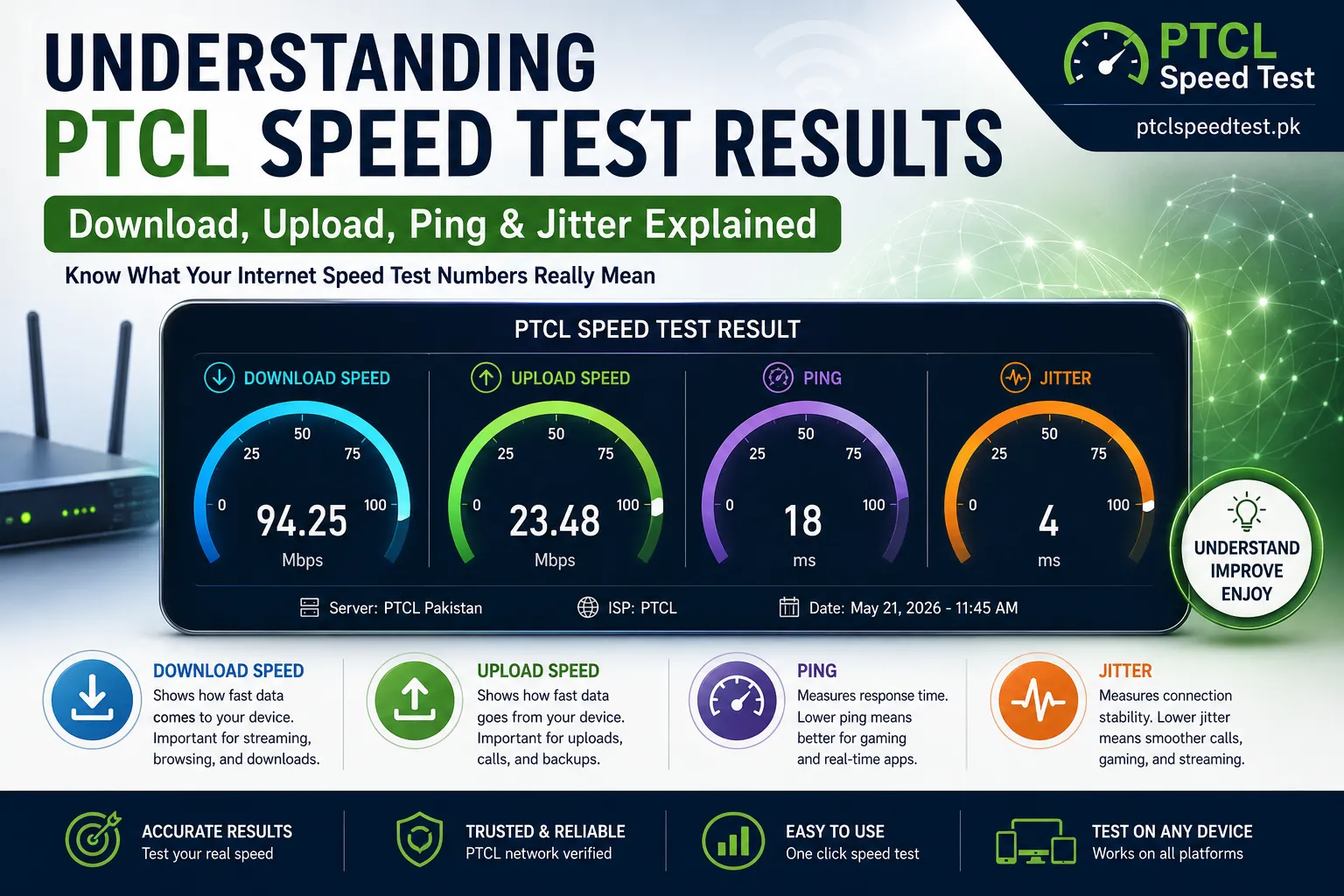
- Understanding PTCL Speed Test Results — what download, upload, ping, and jitter mean in detail
- PTCL Ping & Jitter Explained — a deeper look at latency and connection stability
- PTCL Router Restart Guide — general router troubleshooting steps
Common Problems
Speed test not loading. It’s usually a signal or connectivity issue rather than a problem with the tool — confirm you have an active data connection first.
High ping despite good download speed. Points toward network routing or congestion rather than a bandwidth issue — try testing at a different time of day.
Poor upload speed specifically. Often more noticeable on mobile networks than download issues — check for background uploads or syncs running simultaneously.
Indoor signal weaker than outdoor. Expected in many buildings, since concrete and metal weaken mobile signal — test near a window to compare.
Slow internet despite full bars. Signal strength doesn’t guarantee speed — tower congestion or a device limitation can still be the cause.
APN-related connection problems. If data won’t connect at all despite good signal, request fresh settings by texting your phone model to 222 or calling 333.
Expert Tips
- Test at multiple times of day for a representative picture rather than judging from a single result.
- Compare your result against your specific plan’s intended speed rather than a generic benchmark.
- If you rely on Ufone from a consistent location, testing there periodically helps you catch a genuine decline early.
- Don’t assume a single poor result reflects a permanent problem — mobile performance naturally fluctuates more than a fixed connection.
- If you were previously a Telenor customer transitioned to Ufone, it’s worth re-testing your speed and re-checking your APN settings, since the underlying network you’re connected to has changed.
- Speed test results can vary depending on the testing server. A nearby server generally produces lower latency than a distant one.
- Battery Saver or Low Power Mode may reduce mobile network performance on some devices.
- On dual-SIM phones, confirm mobile data is assigned to your Ufone SIM before testing.
Frequently Asked Questions
How do I test my Ufone internet speed? Use the free speed test tool on this page. It works on desktop, Android, iPhone, and standalone 4G/MiFi devices, measuring download speed, upload speed, and ping in under a minute.
Is this Ufone speed test accurate? Yes — it measures your live connection in real time. Test a few times at different points in the day for the most reliable picture.
Does the speed test use my Ufone data? Yes, a small amount, comparable to loading a webpage — negligible against a typical daily allowance.
Why is my Ufone internet slow even with full signal bars? Full bars indicate strong reception, but speed can still be limited by tower congestion, background apps, or a device that doesn’t fully support the network’s capability.
Does Ufone have 5G in my city? As of this writing, Ufone’s 5G is active only in select parts of Islamabad, well behind Jazz and Zong’s rollout. Check Ufone’s official coverage information before assuming availability elsewhere.
What are Ufone’s APN settings? Commonly APN: ufone.internet, MCC: 410, MNC: 03 — though the most reliable method is texting your phone model to 222 or calling 333 for current official settings.
What’s a good download speed for Ufone 4G? It depends on usage — 5-10 Mbps comfortably covers browsing and HD streaming, with higher speeds benefiting heavier use where available.
Can I use Ufone as my home internet instead of PTCL? It’s possible, particularly without fixed-line access, though mobile performance is generally less consistent than a dedicated home connection like DSL or Flash Fiber.
Why does my Ufone speed change throughout the day? Peak-hour congestion, typically in the evening, commonly causes fluctuating mobile speeds on any network.
Is Ufone 5G available on all phones? No — your device needs to be 5G-compatible, and even then, 5G is only useful within Ufone’s very limited current coverage area.
What happened to Telenor in Pakistan? Telenor Pakistan was acquired by PTCL and formally merged into Ufone (PTML) as of July 1, 2026. Telenor no longer operates as a separate network in Pakistan.
Will my old Telenor SIM still work? Former Telenor subscribers are now part of Ufone’s network following the merger — if you’re experiencing issues, contacting Ufone support directly is the best way to confirm your specific account status.
Does a VPN slow down my Ufone speed test result? Yes, generally, since a VPN adds an extra routing step that typically reduces speed and increases ping.
Why is my upload speed lower than my download speed on Ufone? This is standard across most mobile and fixed connections, since networks generally prioritize download bandwidth over upload.
Can weather affect my Ufone internet speed? It can, particularly during heavy rain or storms, especially in areas with already weaker coverage.
Should I restart my phone if Ufone internet feels slow? Yes — it’s a reasonable first step that resolves many temporary connection issues without further troubleshooting.
Is Ufone faster than PTCL Flash Fiber? They’re different connection types. Flash Fiber generally offers more consistent performance at a fixed address, while Ufone offers mobility — the better choice depends on your situation.
How often should I test my Ufone speed? Testing periodically, and especially when something feels off, helps you understand your typical performance and notice genuine changes over time.
Does my phone model affect my speed test result? Yes. Older devices, or ones that don’t support the network’s full available bands, can cap your result below what the network actually delivers.
What should I do if my Ufone speed is consistently poor? Check signal strength, verify your APN settings, restart your device, test at different times and locations, and contact Ufone support (333) if the issue persists.
Can incorrect APN settings cause slow speed instead of no connection at all? In some cases, yes — a partially misconfigured APN can allow a connection while still limiting performance, which is why checking your settings is worth doing even with some data connectivity present.
Conclusion
Run the Ufone Speed Test above to check your real download speed, upload speed, and ping. If results are lower than expected, work through the signal and APN troubleshooting steps in this guide before contacting Ufone support — and if you’re also managing a PTCL connection at home, [Why Is My PTCL Internet Slow?] covers fixed-line troubleshooting in more depth.